

How to Choose a Commercial Meat Cutting Machine
Choose a commercial meat cutting machine by the condition of the meat and the cut you need, then verify the complete workflow. Prepared fresh boneless meat, tempered blocks and bone-in portions are different jobs. A machine that makes slices is not automatically a dicer, and consistent slice thickness does not guarantee a fixed portion weight. At Jiaxuan Machinery, we use these distinctions to narrow the equipment choice before comparing listed capacity.
Start with the material at the cutting point
Describe the meat as it will enter the machine, not just as “beef” or “frozen.” Record whether it is boneless, its usual dimensions, firmness and measured temperature at loading. Include fat layers, tendons and irregular pieces in the brief. Here, tempered meat means frozen material brought to a condition suitable for the selected cutting system; it does not mean every frozen block is ready to cut.
The JX-300 meat cutter for slices, strips and dice is positioned for prepared fresh or lightly chilled meat and is not intended for hard-frozen blocks or hard bones. The JX-25 frozen meat slicer and portion cutter uses a gripper and controlled feeding for suitably prepared frozen or tempered products. Its suitability for a particular bone-in product requires confirmation; “bone-in” alone is not enough to select a machine.
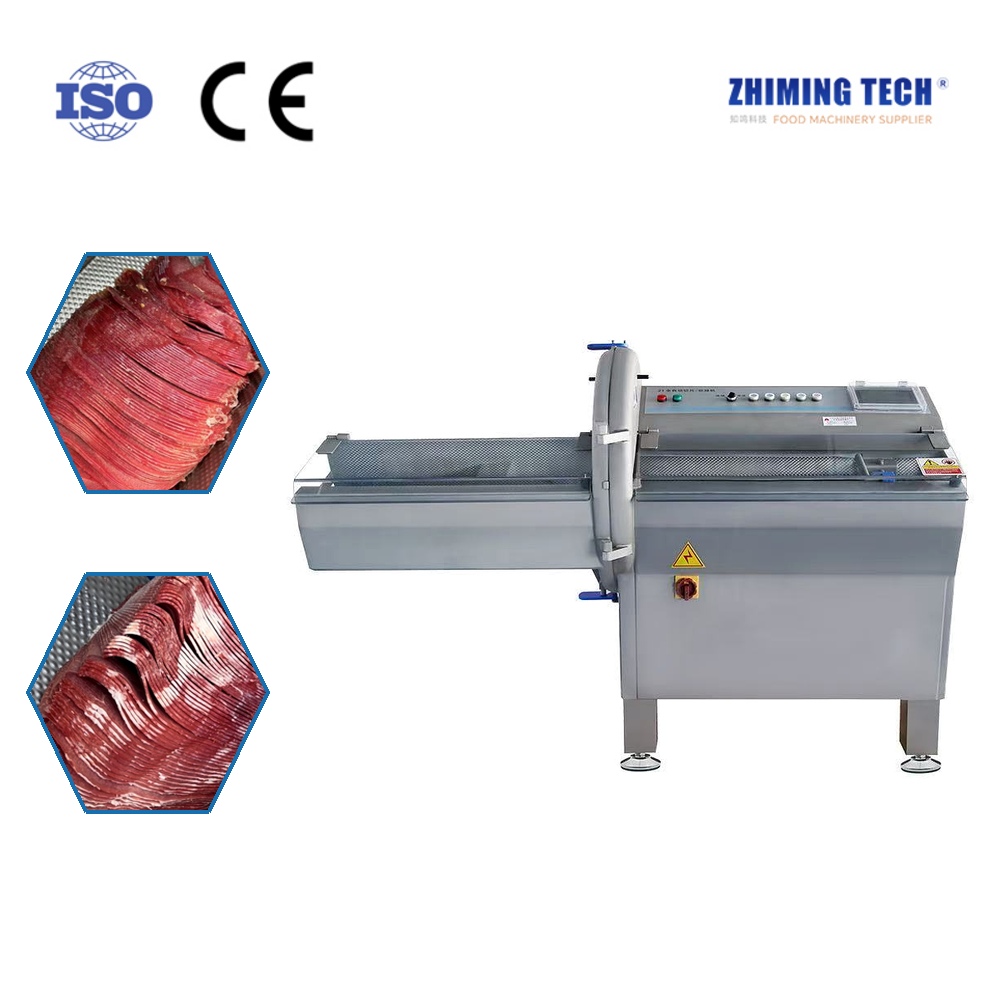
JX-25 equipment photo from our product page. The picture identifies the machine; it does not demonstrate performance with your raw material.
Match the cutting route to the finished product
Write the saleable specification first. For slices, state thickness and acceptable variation. For strips, add width and length. For cubes, specify all three dimensions. If portions are sold by weight, define a separate weight acceptance range and how weighing or pack adjustment will be handled.
| Production requirement | Starting equipment route | Decision check |
|---|---|---|
| Several cut formats from prepared fresh boneless meat | JX-300 with the matching knife group and cutting sequence | Count reorientation, repeat passes and handling; do not assume every format is completed in one pass. |
| Repeated slices from suitably prepared frozen or tempered blocks | JX-25 with controlled feeding and gripping | Check block fit, holding stability, the last slices and end-piece handling. Confirm bone suitability separately. |
| A regular boneless meat cube product | Dedicated fresh meat dicer with grid and cross-cutting knife | Check preparation and chamber fit, then inspect all three dimensions and fragments after transfer. |
The dedicated JX-350 and JX-550 fresh meat dicing machines use coordinated pushing, grid cutting and cross-cutting to produce cubes in one processing cycle. They are intended for prepared boneless meat. The trade-off is a more focused dicing route versus the JX-300’s flexibility across formats; neither choice removes preparation, cleaning or loading work.
These equipment distinctions are based on the linked product descriptions. For the detailed sequences, see how we configure the JX-300 for slices, strips and cubes and the JX-25 feeding and cutting process. This guide compares selection routes rather than repeating their model specifications.
Compare usable output across the whole job
A listed machine capacity describes an equipment specification under its stated conditions. Your production requirement is accepted product delivered to the next operation. A fast cutting stage can still wait for trimming, loading, repeat cutting or collection.
For a representative trial, record accepted output mass and elapsed working time over a clearly defined run. Accepted output rate (kg/h) = accepted output mass (kg) ÷ elapsed time (h). Include the preparation and handling steps you want the comparison to cover, and use the same boundary for every candidate. Record changeover and cleaning separately so a short demonstration is not presented as sustained shift output.
For example, a kitchen changing between strips and dice should compare the complete format change and handling sequence. A line making one cube product should compare repeatable delivery to mixing or packing. These are planning examples, not measured results or claims of guaranteed savings.
A trial acceptance checklist for the purchase decision
Representative input: include normal small and large pieces, layered cuts and other difficult material that falls within the proposed machine specification.
Agreed output: define dimensions, acceptable variation, fragment limits and any separate weight target before running the sample.
Samples across the run: check early, middle and final output. Include end pieces and rejected material in the record.
Downstream fit: inspect the product after ordinary transfer to the actual tray, mixer or next process; count rework as well as attractive samples.
Operating fit: confirm loading and discharge space, operator access, knife changes, cleaning access and electrical requirements for the quoted configuration.
Review the machine instructions and your site procedures for blade handling and cleaning. Isolate power before accessing cutting components. A stainless steel body alone does not establish food-contact compliance, a cleaning method or a certification for every destination; request the relevant documentation for the supplied configuration.
Questions buyers should settle before ordering
Can one meat cutter cover fresh meat, hard-frozen blocks and bones?
Do not assume it can. JX-300’s stated exclusions differ from the JX-25’s product-dependent suitability. Describe the hardest normal material and obtain confirmation for the exact configuration. If that material is outside the proposed route, reconsider the equipment rather than forcing it through.
Does an adjustable slicer deliver fixed-weight portions?
No. Slice thickness and portion weight are different acceptance criteria. A changing cross-section changes piece weight even when thickness is consistent. Our JX-25 thickness-versus-weight guide explains the checks to make when tray weight matters.
When should we compare a multifunction cutter with a dedicated dicer?
Compare them when cubes are a significant part of the schedule. Measure the same finished cube requirement, preparation and handling. A focused dicing route may suit repeated cube production; a multifunction route may suit changing formats if the extra passes and changeovers remain practical.
Send a cutting brief, not just an hourly target
To discuss a suitable route, provide meat type, bone status, loading temperature and firmness, starting dimensions, target finished dimensions and tolerances, required accepted output per hour or shift, product mix, available space, destination country and electrical supply. Add raw-material photos and an example of an acceptable finished cut.
Send your meat cutting requirements to Jiaxuan Machinery so we can discuss the appropriate equipment and the checks needed before confirming a quotation.
Flowing: