

Root Vegetable Washing and Peeling: A Trial Acceptance Guide
Judge root vegetable washing and peeling by four results together: the required surface finish, accepted usable yield, rework and output over a complete cycle. A clean-looking potato is not enough to approve a machine if excessive flesh is removed or the batch needs substantial hand trimming. At Jiaxuan Machinery, we recommend agreeing on the finish and measurement method before comparing equipment or trial settings.
Define “acceptable” before loading the batch
Washing removes soil and surface residue. Abrasive peeling removes skin through mechanical contact and can also remove edible material. A skin-on washed product, a lightly peeled product and a product peeled for dicing therefore need different acceptance rules.
Write down what must be removed, what may remain and the next operation. For skin-on potatoes, unwanted skin removal is a defect. For peeled carrot dice, retained peel that requires trimming may be a defect. For irregular ginger, inspect recesses as well as the exposed surface. Agree on an inspection method and sampling points rather than inventing a universal acceptable peeling percentage.
Visible cleanliness is a physical inspection result. It is not proof of microbial safety, pesticide removal or disinfection. Follow the process controls and verification required for your product and market; brush contact and water rinsing alone do not establish those outcomes.
Choose the process that matches the finish
Our commercial root vegetable brush washing and peeling machine turns firm roots against rotating brushes while water carries away soil and separated peel. Its product description identifies crop firmness, skin condition, brush configuration, batch loading, water flow and processing time as factors in the result. Longer contact can increase peeling, but excessive processing can increase material loss. This route is intended for firm roots such as potatoes, carrots and sweet potatoes; soft fruit and leafy vegetables need a different washing approach.
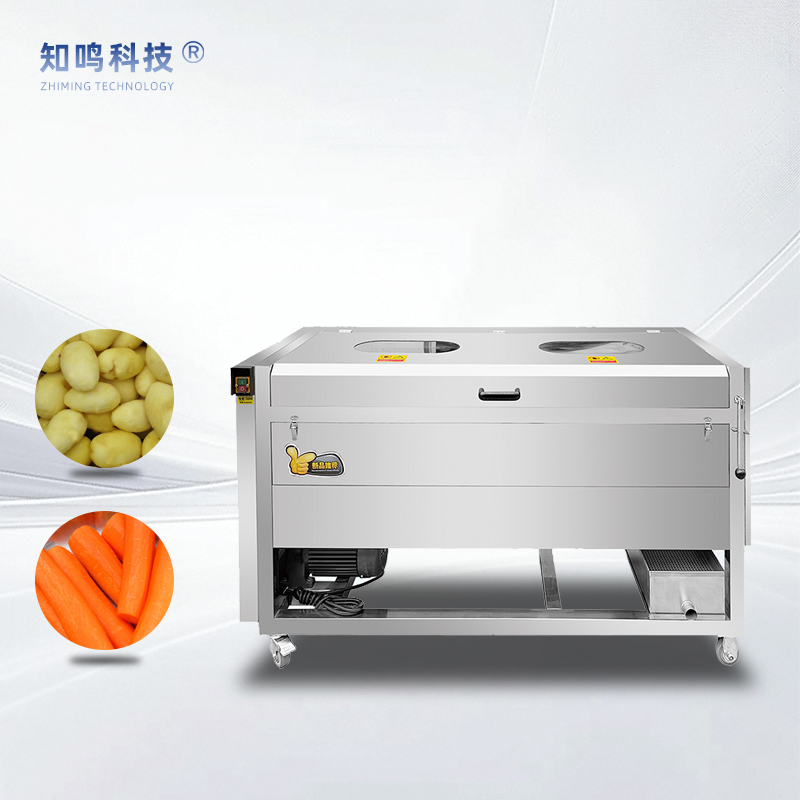
Existing equipment photo from our root vegetable product page. A surface finish or loss rate must be evaluated using representative produce, not inferred from the machine photo.
When the target is washing without abrasive peeling, compare the air-bubble and spray vegetable washing system. Its described process uses water agitation followed by a spray rinse and conveyor discharge. It is a washing route, not a substitute for a peeler. Adding a second washing stage should solve an identified requirement; it should not be assumed necessary for every line.
For model sizes, use our existing five-size brush washer-peeler range overview. Our brush peeling and bubble washing comparison explains the different finished-product goals.
Make the before-and-after weights comparable
Do not label every difference in weight “peeling loss.” Mud, water, removed skin, edible flesh and rejected pieces can all change a measurement. Comparing muddy incoming roots with wet outgoing roots gives an ambiguous result.
Choose a weighing boundary. To compare the peeling stage, establish a baseline after comparable soil removal and drainage. If that is not practical, report the whole-process yield from incoming produce and state that soil and preparation losses are included.
Use the same drainage method. Agree on how input and output are drained, use the same scale and record the method. Do not compare freshly rinsed wet produce with a drained reference batch.
Separate the outputs. Record acceptable produce, material requiring rework, rejected pieces and collected residues where practicable. Weigh the final accepted product after any required hand trimming.
Record the starting crop. Include variety, size spread, firmness, skin condition, soil load and pre-existing damage. Do not attribute incoming defects to the machine.
Accepted usable yield (%) = final accepted output mass ÷ baseline input mass × 100. Both masses must use the agreed boundary and drainage method. This is a proposed trial calculation, not a published performance claim. Its complement is material outside the accepted output within that boundary; it is not automatically edible-flesh loss. If absorbed or retained water changes the balance, explain that limitation instead of presenting the result as an exact loss rate.
A trial record that supports an acceptance decision
Set the buyer’s acceptance limits before the run. The following record is a proposed method, not a report of an actual customer test.
| Check | Record | Decision value |
|---|---|---|
| Surface finish | Residual soil or peel, recesses, scuffing and broken pieces across the batch | Accept only against the agreed skin-on or peeled finish; sample ordinary pieces, not only the best examples. |
| Usable yield and rework | Baseline mass, final accepted mass, rework mass and trimming time | Reject an apparently clean result if its yield or rework exceeds the buyer’s agreed limits. |
| Cycle and output | Loading, processing, discharge, inspection and required transfer time | Compare accepted kg/h over the same full-cycle boundary, not brush-running time alone. |
| Repeatability | Crop condition, brush setup, load, water supply and settings for successive batches | Confirm normal batches meet the target without an exceptional amount of operator adjustment. |
Accepted output rate (kg/h) = final accepted mass (kg) ÷ recorded cycle time (h). State whether downstream trimming is included. Record cleaning and changeover separately when planning a shift, because a successful short run does not prove continuous output across a changing crop supply.
Improve the result without changing every variable
Soil remains in grooves, but exposed surfaces are already over-peeled
Extending the run may remove more flesh without solving the recess problem. Compare similarly sized roots, review brush configuration and water removal of residues, and repeat the test within the machine’s instructions. The ingredient’s geometry may require sorting or additional handling; do not promise the same finish on every shape.
Clean appearance comes with too much rework or low usable yield
Check incoming damage, drainage consistency and the weighing boundary first. Then compare processing duration and load against the agreed finish, changing one controllable factor at a time. A shorter run is only an improvement if it still satisfies the cleaning or peeling requirement.
A good small batch becomes uneven at the proposed production load
The brush-machine product description warns that overloading can restrict movement. Compare batch loading and crop size distribution, then check discharge and handling time. Choosing a larger model may help with volume, but does not by itself establish a suitable brush setup or acceptance result.
Buyer questions before accepting the trial
Can a potato trial establish the result for ginger or carrots?
No. Crop shape, skin and firmness affect brush contact and the required finish. Use each planned crop in the trial programme, including ordinary variation within that crop. A result from one ingredient is not a guaranteed setting or yield for another.
Should hand-trimmed pieces count as machine output?
Keep two records when trimming is needed: acceptable product immediately after the machine and final accepted product after trimming. Count the trimming time and labor when evaluating the complete process. Otherwise, an attractive final batch can hide a machine result that needs substantial rework.
Prepare the trial brief before requesting a quotation
Send crop and variety, incoming photos, usual size range and soil condition, the required finish, next operation, target accepted quantity per hour or shift, and your acceptable rework and yield criteria. Add the available space, water supply, drainage arrangement, destination country and electrical requirements. If you already have a test record, include its weighing boundary and settings.
Discuss your vegetable washing and peeling requirements with Jiaxuan Machinery. A clearly defined finish and trial record provide a better basis for equipment selection than a photograph of one peeled vegetable.
Flowing: