

Burger Patty Forming Trials: Test Your Recipe Before Buying
A useful burger patty forming trial uses your actual prepared mixture, the proposed mold and the handling that follows forming. Approve the combination only when it fills and releases consistently, produces acceptable portions and survives transfer to the next step. A round outline in a demonstration does not establish that a different beef, chicken or vegetable recipe will behave the same way.
At Jiaxuan Machinery, we distinguish the forming job from the cutting job. A patty former receives a prepared mixture; it does not turn whole meat into mince. Our JX-100 burger patty forming machine combines feeding, portioning, interchangeable mold forming and conveyor discharge. The linked product description identifies moisture, particle size and binding properties as factors in release and shape stability. Those are the variables the purchase trial needs to make visible.
Write the patty specification before changing the recipe
Begin with the product the buyer intends to sell: shape, dimensions, target weight and acceptable variation. Record where these are assessed. A raw patty at discharge, a frozen patty in a pack and a cooked patty on a bun are different checkpoints.
A mold establishes the intended outline, while the way the mixture fills and releases affects the product delivered. Even when nominal dimensions are unchanged, the same weight result should not be assumed for another mixture. Weigh the output rather than treating mold size as a weighing system.
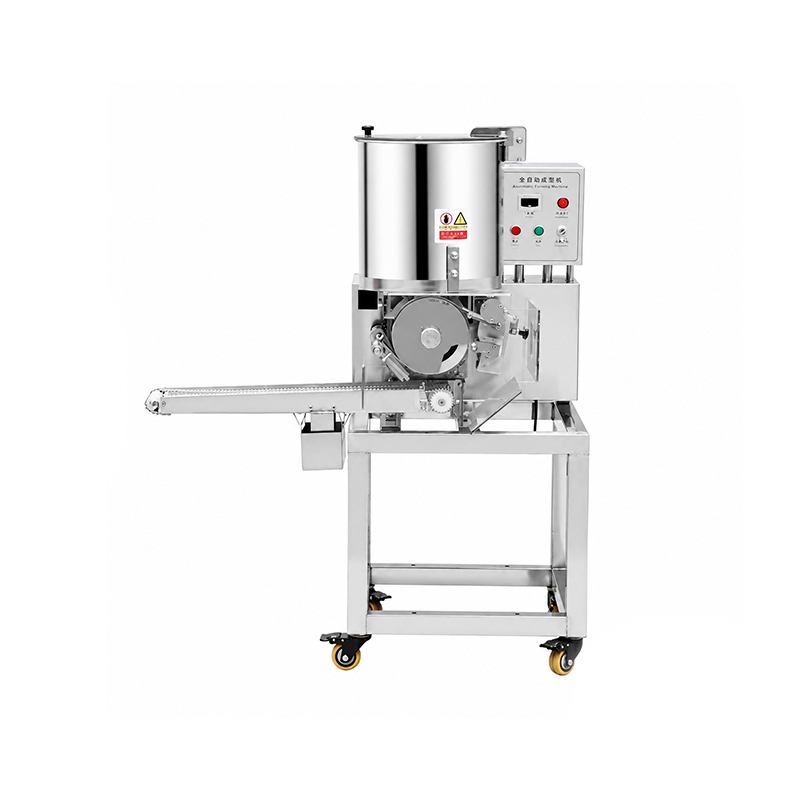
Existing photo from our patty former product page. Recipe performance must be established with the proposed mixture and mold.
Make a repeatable recipe trial card
Use a written recipe version and record the preparation method. For minced meat, include the grind or particle specification, mixing sequence and condition when presented to the former. For a mixture containing vegetables or other inclusions, include their size and preparation. Record the mixture temperature at the time of the run; this guide does not prescribe a universal processing temperature.
Keep the mold and the agreed product target constant while comparing recipe versions. If the mixture, mold and machine setup all change together, the reason for an improved result is difficult to identify. Any machine adjustment should follow the instructions for the supplied configuration.
| Checkpoint | What to record | What the result tells the buyer |
|---|---|---|
| Filling and portion repeatability | Actual recipe version, mold, mixture condition and consecutive patty weights | Whether the proposed combination delivers the required portion consistently, rather than only producing a few acceptable examples. |
| Release from the mold | Incomplete outlines, material remaining on the mold, sticking and damaged edges | Whether the recipe and mold require further evaluation before an order is confirmed. |
| Conveyor and tray transfer | Shape immediately after release and after normal collection or transfer | Whether deformation begins at forming or is introduced by the next handling step. |
| Next production stage | Condition after the buyer’s normal freezing, coating or cooking process, where relevant | Whether a formed patty is suitable for the intended product, not merely attractive at discharge. |
Separate a forming problem from a handling problem
Follow the same sample group through the process. If the outline is incomplete as it leaves the mold, record the filling and release observations before looking downstream. If patties leave intact and deform only when collected or transferred, investigate that transfer with the receiving operation. The two observations point to different questions.
For sticking, note where it occurs: at the mold, on the conveyor or between products during collection. Keep the recipe record beside these observations. The product page warns that excessively dry, watery or coarse mixtures can require formulation work, but it does not supply a universal recipe correction. Adding water, binders or another ingredient without recording the change makes the next comparison harder to trust.
This is a proposed evaluation method, not a report of a measured customer result. It also avoids attributing every defect to the former when preparation or subsequent handling has changed.
Measure consistency without inventing a tolerance
Agree on the acceptable weight and dimensional limits with the buyer before running the sample. Collect consecutive products at several points during a representative run, including after ordinary replenishment of material. Record each measurement, the number outside the agreed limits and any manual rework.
Keep formed pieces, accepted pieces and reworked pieces separate in the record. If output matters, count accepted patties over a stated time interval and record loading, collection and interruptions alongside it. Do not convert an uncertain headline capacity into a promised production rate.
Questions to resolve before selecting the mold
Does success with beef establish suitability for chicken or a plant-based recipe?
No. The product range includes different prepared mixtures with suitable consistency, but each recipe remains a separate forming question. Compare its filling, release and handling with the proposed mold. Compatibility in a product list is a starting point for evaluation, not a result for an untested formula.
What should we check for a shaped product with narrow points?
Inspect those points after release and again after transfer. The mold defines the intended shape; the finished mixture must retain it through the actual process. Confirm the proposed shape and dimensions before ordering a custom mold rather than relying on a photograph of a different product.
Send a recipe and finished-product brief
For a useful quotation discussion, provide the prepared mixture type, particle or inclusion sizes, recipe version, loading condition, target shape and dimensions, portion weight and tolerance, required accepted output, and the next handling or processing stage. Add the destination country, electrical supply and available space.
If your project begins with whole meat, our commercial meat cutting machine selection guide explains the separate cutting routes. For this forming stage, send Jiaxuan Machinery your patty specification and recipe trial requirements so the mold and proposed configuration can be discussed against the product you plan to make.
Flowing: