

How Our V-Type Vegetable Slicer Keeps Long Produce Aligned
A cucumber can look straight on a preparation table and still rotate as it enters a cutter. A carrot may taper; an eggplant may have a wider middle than either end. If these long ingredients change direction before each cut, specifying a fast blade alone will not give a consistent result. With our V-Type high-speed industrial vegetable slicing machine, we start by controlling how the vegetable travels toward the cutting area. Then we select the cut that the finished product requires.
Why the V-shaped path comes first
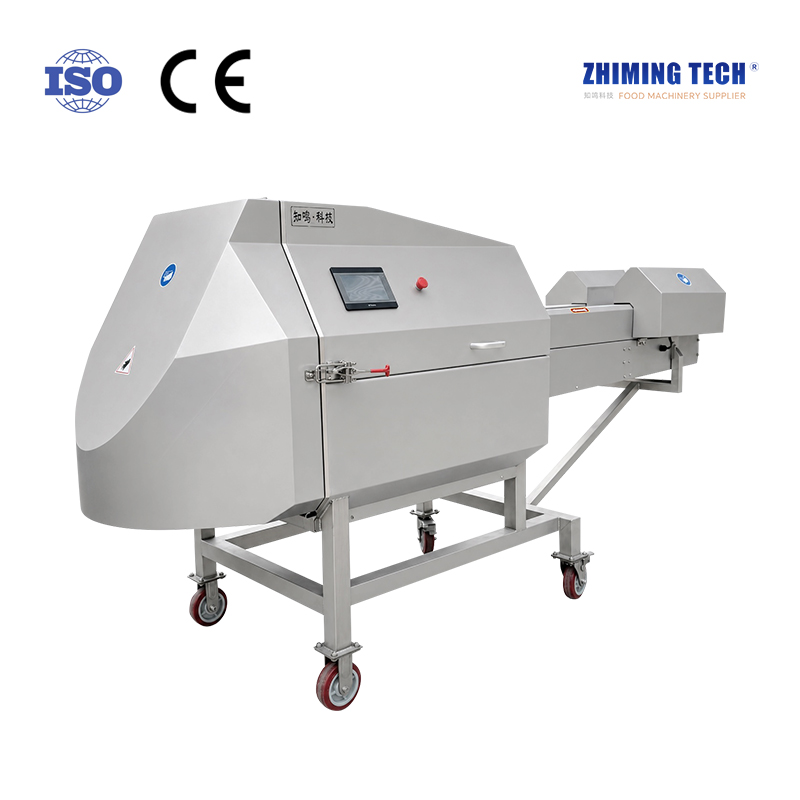
Our V-shaped feeding channel supports a long vegetable from two sides as the conveyor belts move it forward. That geometry matters for cucumbers, carrots, radishes and other round or oval ingredients that might roll on a flat belt. Holding the ingredient in a repeatable orientation gives the cutter a more predictable presentation at each pass. It does not make every raw vegetable identical: a crooked piece, a large change in diameter or a soft surface can still change how it feeds.
We therefore ask buyers for the real size range of their produce, not just an average diameter. The conveyor belt width in this configuration is 100 mm; that is a machine specification, not a universal maximum diameter for every ingredient. We confirm whether the smallest, largest and least regular pieces sit and travel securely in the V channel during a sample run.
Follow the vegetable from entry to cross-cut
We prepare the material for the desired product first: remove unsuitable pieces, decide whether washing or trimming belongs upstream, and define how the slices will be collected. The operator places suitable long produce into the V-shaped feed path. The moving belts guide it toward the cutting assembly while helping limit sideways movement or rotation. The cutter then makes a transverse cut across the advancing ingredient, producing a succession of rounds or oval slices as the material continues forward.
The sequence explains why we evaluate vegetable alignment and slice quality together. If the product slips or bounces, a well-chosen blade cannot compensate for inconsistent presentation. We also check the transition from the final cut to discharge: piled-up slices or rough handling can damage a product that looked good at the blade.
Three controls that solve different questions
| Decision | What it affects | What we confirm |
|---|---|---|
| Conveyor speed | How quickly material is supplied to the cutting area | Stable feeding and the usable output at the chosen setting |
| Cutting configuration | Whether the installed setup makes flat or wavy slices | The specified cut style and its effect on the actual ingredient |
| Required slice thickness | The finished-product specification to be matched by the configured machine | Measured thickness and acceptable variation in a sample trial |
The touchscreen lets an operator adjust conveyor speed. A request for flat vegetable slices versus wavy vegetable slices calls for the appropriate cutting configuration; it should not be treated as a touchscreen-only change. Likewise, we agree on the target thickness and ingredient before confirming the machine's cutting setup. This distinction prevents a common misunderstanding: increasing feed speed may change the rate of supply, but speed alone is not a finished-cut specification.
Match the vegetable to the cut it needs
Cucumbers and carrots are familiar examples, but they place different demands on the feed and blade. A firm carrot may hold its shape yet taper substantially. A cucumber can vary in diameter and surface condition. White radish provides a longer, heavier test piece; eggplant and zucchini introduce softer flesh and potentially greater deformation. Loofah and other long vegetables should be judged on their actual firmness and intended slice. We do not assume that settings proven for one crop transfer unchanged to another.
Before recommending a configuration, we ask what happens after slicing. Pickle processing may need regular cucumber rounds; a frozen vegetable line may prioritize pieces that survive downstream handling; a central kitchen may care about presentation and preparation time. The same industrial vegetable slicer can serve different lines, but the acceptance standard should be tied to the buyer's finished product, not to a generic photograph of slices.
Plan the line around real throughput
Our V-Type configuration is specified for approximately 3,000–5,000 kg/h under suitable conditions. That range is a planning reference, not a guarantee for every crop or slice style. Real usable output depends on ingredient size, feed rhythm, conveyor setting, blade configuration, rejected pieces and the capacity of the equipment receiving the slices. We measure both the material entering the process and the saleable output over a stated test interval.
For installation planning, this configuration uses 380 V with 3.0 kW rated power and measures approximately 2,900 × 950 × 1,500 mm. We also allow for working space around infeed, discharge, blade access and cleaning; the machine footprint alone is not the whole line footprint. Its 304 stainless-steel body and lockable casters assist positioning and routine access, while the final electrical supply, cutting setup and cleaning procedure should be confirmed for the destination site.
Run straight, tapered and soft pieces in the same trial
We ask for samples from the normal size range, including curved, tapered and softer pieces. For each requested cut, we run enough material to observe whether it stays centered, how often an operator must reposition it and whether the first and last slices remain usable. We inspect cut face, thickness, broken pieces and the way slices leave the machine. If a wavy style is requested, we examine that configuration separately from the flat cut.
We then record input weight, accepted output and elapsed operating time with the ingredient and settings noted. That gives the buyer a defensible answer to two separate questions: can the machine produce the specified slice, and can the surrounding line handle it at the required rate?
Specify the vegetable and the acceptable slice
Tell us the vegetable varieties, minimum and maximum sizes, desired flat or wavy style, target slice thickness, expected throughput and local power supply. Photos of the raw material and a sample of the finished slice make our discussion more precise. We can review the appropriate cutting configuration, arrange a test and confirm the final specification. Explore our fruit and vegetable processing equipment or contact Jiaxuan Machinery with your application details.
Flowing: